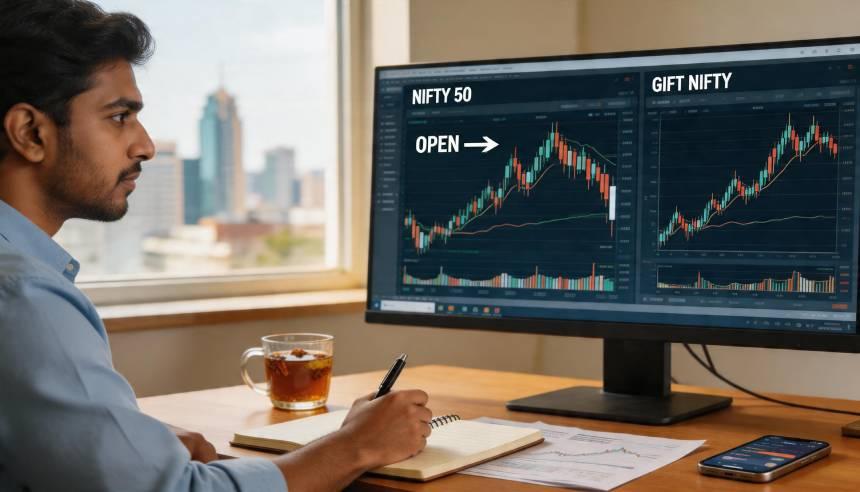
Every serious participant in the Indian equity market knows that the game begins well before the opening bell rings at 9:15 AM. Seasoned traders keep a close eye on the SGX Nifty Live feed in the early hours of the morning, as it provides a reliable early signal of how the domestic benchmark may behave once markets open. Similarly, monitoring the Nifty Future Live movement helps traders understand the sentiment and momentum that is building up in the futures segment, enabling them to make sharper entry and exit decisions. These two tools, when understood correctly, can significantly change the way you approach trading in the Indian markets.
Why Pre-Market Intelligence Matters More Than Ever
The Indian stock market has matured considerably over the past decade. Retail participation has exploded, institutional activity has deepened, and algorithmic trading now accounts for a meaningful chunk of daily volumes. In such an environment, walking in blind at 9:15 AM is no longer a sound strategy. Traders who spend the early morning hours studying pre-market signals tend to be far better prepared than those who react to market moves after they have already happened.
Pre-market intelligence is not just about knowing which direction the index is likely to open. It is also about understanding the strength of that move. A weak gap-up supported by thin volumes tells a very different story from a strong gap-up backed by broad participation. Reading these signals correctly comes with practice, but it begins with understanding what each indicator is telling you.
The Role of Singapore-Based Futures in Predicting Indian Opens
The Singapore-based futures contract linked to the Nifty 50 index trades in a time zone that gives it a head start over Indian market hours. This means that by the time Indian traders wake up, this contract has already been priced in global overnight developmentswhether it is movement in major global indices, commodity price shifts, currency fluctuations, or geopolitical news. The data from this contract serves as one of the most widely tracked pre-market indicators in India.
Traders use this information to estimate whether the Nifty 50 is likely to open with a positive or negative gap. Experienced participants cross-check this with domestic factors such as institutional buying or selling data from the previous session, F&O open interest positions, and the overall trend of the index. When all these signals align in one direction, the probability of a clean trade setup increases substantially.
Understanding the Futures Segment Before Markets Open
The Nifty futures segment is where institutional players, high-net-worth individuals, and professional traders concentrate much of their activity. Watching how this segment behaves in the pre-open periodparticularly in the first fifteen minutes of the market sessioncan tell you a great deal about where prices are headed.
For instance, when futures consistently trade at a premium to the spot price, it signals bullish sentiment. When they trade at a significant discount, it often indicates bearish expectations or heavy hedging activity. Monitoring the basisthe difference between futures and spotis a practice that every intermediate-to-advanced trader should incorporate into their daily routine.
How to Build a Morning Routine Around Market Signals
The most underrated behaviour of profitable investors is their morning practice. An established premarket regular could make the difference between going into stores with conviction and stumbling into places reactively.
Start by checking listings before opening from 10 a.m. to 1 p.m., 7:00 to 10:00 p.m. Couple this with expertise on the broader market trend: Is the Nifty 50 currently in an uptrend, downtrend or consolidation phase?
Then evaluate the F&O information from the previous session. See which strike prices carry good open interest for calls and puts, as these levels often act as support and resistance. Check to see if large free interest has been delivered or reduced in key moves, as this can result in a directional bet through shrewd cash.
Integrating Technical Analysis With Pre-Market Data
A market forecast should not be used alone. Quality investors combine multiple data factors to create a coherent picture. Technical analysis – chart patterns, moving averages, extension estimates – should be layered on top of pre-market awareness to sharpen change setups.
For example, if the overnight signal indicates that an opening is about to start and the daily chart shows that the Nifty 50 is approaching a key resistance level, a prudent trader will not buy the opening blindly. Instead, they wait to watch the market react to that resistance before capitalising.
Discipline and Risk Management Remain Paramount
No matter how accurate your pre-market reading is, markets can and do surprise. Managing risk through proper position sizing, stop-loss placement, and disciplined exit strategies is what separates consistently profitable traders from those who have occasional wins followed by significant drawdowns. Pre-market intelligence improves your odds; it does not eliminate uncertainty.
Also read about: The Precision Saw Cut Advantage For Clean Bone Marrow Pieces In Rich Curries



Recent Posts